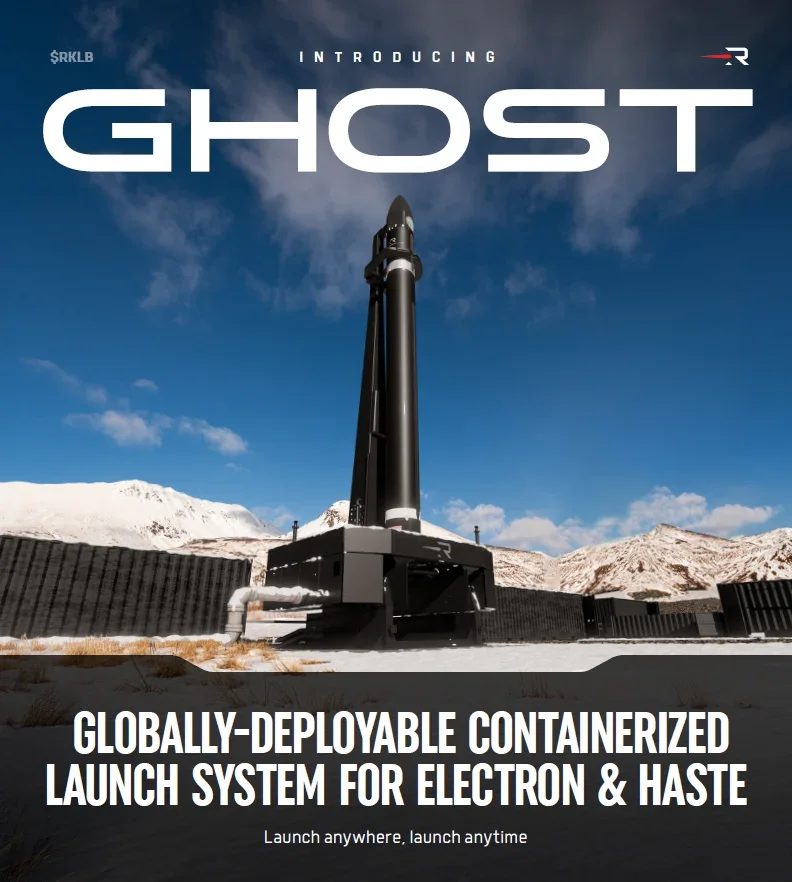
10 Details Behind Rocket Lab's GHOST Deployable Launch System
Rocket Lab's containerized GHOST system packs Electron and HASTE launches into shipping containers, with the first deployment set for Alaska in 2027.
Source material: satcom.digital
A launch site that ships as freight
- Vehicle: Electron & HASTE
- Role: Deployable launch
GHOST packs an entire launch site into standard shipping containers, the same boxes that move freight through global logistics networks every day. Rocket Lab's design puts the complete Electron or HASTE rocket, launch infrastructure, ground support, and range control systems into containers that travel by truck, ship, or rail to any destination. The modular footprint means a launch capability can arrive at a site and operate without building permanent structures. Because every component moves inside the same standardized containers, the system can reach airfields, ports, and road networks alike. The containerized packaging does not just shrink a launch complex; it turns the launch site itself into cargo. Rocket Lab positions GHOST as the delivery mechanism for its existing Electron and HASTE vehicles, so the system runs on proven hardware rather than a new rocket.
The acronym points at two rockets
- Company: Rocket Lab
- Vehicle: Electron & HASTE
- Role: Global deployment
GHOST stands for Global Hypersonic & Orbital Spaceport Technology, and the acronym maps directly onto Rocket Lab's two existing vehicles. 'Hypersonic' points to HASTE, the suborbital rocket built for high-speed flight profiles. 'Orbital' points to Electron, the vehicle that has become Rocket Lab's mainstay for small satellite delivery. Rocket Lab trades on Nasdaq under the ticker RKLB. The company chose the name to communicate that a single deployable system covers both regimes rather than requiring separate infrastructure for each. Aerospace naming tends toward utility, but GHOST also carries a marketing punch: a system that can appear at any coastline or airfield, launch, and pack itself back into containers. The acronym's final word, 'Technology,' is the company's hedge — the container system, not any single rocket, is the product being advertised.
First outpost sits on Kodiak Island
- Location: Kodiak, Alaska
- Company: Rocket Lab
- Vehicle: Electron & HASTE
GHOST's deployment starts in Alaska. Rocket Lab's first location for the system, named Rocket Lab Launch Complex 4, will sit at the Pacific Spaceport Complex in Kodiak. The choice of Kodiak brings the containerized system to a site that already has launch infrastructure in place. Rocket Lab's announcement specifies that two pads will be established at the site for high-frequency launch campaigns. The Pacific Spaceport Complex has hosted a variety of commercial and government launches over the years, so Rocket Lab joins an existing aerospace community rather than breaking new ground. The designator — Launch Complex 4 — slots the Alaska facility into Rocket Lab's expanding catalogue of ground infrastructure, which until now has concentrated on New Zealand and Virginia. Kodiak's latitude sits well north of the company's continental U.S. pads, extending reach for missions that benefit from more northerly trajectories.
Two pads run one logistics chain
- Location: Kodiak, Alaska
- Timeline: 2027
- Role: High-frequency campaigns
Kodiak's GHOST installation fields two pads, and both run off the same containerized logistics chain. Rocket Lab designed the two-pad layout to support high-frequency launch campaigns, where missions flow through the same ground infrastructure without tearing down between flights. Because Electron and HASTE share ground support equipment, each pad can switch between suborbital and orbital work depending on the manifest. The two-pad configuration also permits simultaneous launch possibilities, which Rocket Lab says matters for time-critical national security missions. The company's announcement presents the Kodiak pads as the start of a pattern rather than a one-off installation. Two pads at one site are the minimum needed for high-frequency campaigns, since a second pad allows one mission to be integrated while another is on the pad.
Six pads now span two hemispheres
- Location: New Zealand & Virginia
- Vehicle: Electron & HASTE
Adding the two Kodiak pads brings Rocket Lab's total to six launch pads across two hemispheres. The existing network runs from Launch Complex 1 in New Zealand to Launch Complex 2 and Launch Complex 3 in Virginia. A two-hemisphere arrangement matters for orbital mechanics: a Southern Hemisphere site like Launch Complex 1 can place payloads into orbits that are geometrically awkward from northern latitudes, and a northern site like Virginia does the reverse for other inclinations. Kodiak's latitude reaches further north than Virginia, giving the company a high-latitude option in its own hemisphere. Rocket Lab's announcement counts the expanded network as a geographic spread that directly supports the 'anywhere, anytime' positioning of the GHOST system. Mission planners get a menu of latitudes rather than a single fixed point, and each pad can host either vehicle since both share the same ground interface.
One ground system, two vehicles
- Vehicle: Electron & HASTE
- Role: Shared infrastructure
GHOST's dual-launch capability rests on a design choice: the Electron orbital rocket and the HASTE suborbital rocket share the same ground infrastructure. Because both vehicles use the same pad equipment, fueling systems, and integration gear, a GHOST deployment can carry hardware for two mission types without doubling the logistics footprint. Rocket Lab says this lets the system expand the mission profiles of both vehicles, so a single containerized site can serve orbital satellite delivery and hypersonic suborbital testing. For the customer, the practical effect is operational flexibility in the field: an orbital campaign that needs a quick suborbital check flight does not require a second logistics package. The shared infrastructure also shortens the learning curve for ground crews already trained on one vehicle. Rocket Lab has long operated both vehicles, and GHOST is the mechanism that lets a customer take both capabilities to a new location without designing new ground support from scratch.
The first flight is set for 2027
- Timeline: 2027
- Location: Alaska
- Role: Suborbital debut
GHOST's operational debut is scheduled for 2027, with a suborbital launch from Alaska as its first mission. The timeline gives Rocket Lab roughly three years to move from announcement to a working deployed site, including shipping containers to Kodiak, establishing the two pads, and certifying the range and safety systems. The choice of a suborbital mission for the debut suggests a deliberate approach: exercise the containerized logistics and ground infrastructure without the added complexity of reaching orbit on the first attempt. A successful suborbital flight would demonstrate the system's core promise of stand-up capability in a new location, and it would do so on a vehicle, HASTE, that shares Electron's hardware heritage. Rocket Lab has framed the 2027 date as the point at which the containerized system becomes an operational reality rather than a concept, and the Alaska location means the debut doubles as proof of deployment to a remote, cold-weather site.
Responsive launch for missions that cannot wait
- Role: National security
- Vehicle: Electron & HASTE
Rocket Lab built GHOST with responsive launch in mind. The system's modular, small footprint is purpose-built to support time-critical national security missions, and the containerized packaging enables rapid site activation. The company's announcement names missile defense and deterrence as target use cases. In a missile defense scenario, a test may need to fly from a location that matches the geometry of a real threat corridor, and the ability to stand up a launch site quickly at that location is the operational advantage. Rocket Lab's record in small launch for missile defense programs is the track record the company says separates it from competitors, and GHOST packages that record into a portable form. The system's footprint is modular by design, a deliberate contrast with the permanent mega-pads used for heavy-lift rockets.
Sovereign launch without a spaceport
- Role: Sovereign launch
- Vehicle: Electron & HASTE
The international dimension of GHOST is sovereign launch capability. Rocket Lab says the system meets increasing demand from allied nations that want orbital or suborbital launch ability without the decades-long process of building their own spaceports. A containerized system changes the entry economics: instead of constructing permanent infrastructure, a nation receives shipping containers, sets up pads, and runs campaigns with Rocket Lab hardware. The dual-vehicle design means both orbital missions and hypersonic suborbital flights can be offered under the same agreement, covering security and civil demand from one installed base. Rocket Lab's announcement positions this as opening more trajectories, orbital missions, and sovereign launch capabilities in allied nations, making GHOST a diplomatic instrument as much as a commercial product. The same containers that support a missile defense test can also place a satellite in orbit, which is the basis of the sovereign launch pitch: one deployment, two mission classes, and no permanent commitment to a site.
The founder's case for launch-anywhere
- Company: Rocket Lab
- Role: Strategic positioning
Rocket Lab founder and CEO Sir Peter Beck framed the GHOST announcement with the company's record. Beck said its reliability, repeatability, and affordability set it apart in small launch for missile defense and national security, and that GHOST packages that record into a deployable system serving 'the world's most important programs from wherever those missions need.' He named missile defense and deterrence alongside opening more trajectories, orbital missions, and sovereign launch capabilities in allied nations. Beck closed with a standard: launching anywhere, anytime, and without compromise. The sentence carries the weight of the company's existing launch history rather than a promise of unproven technology, which is a stronger position than a new entrant could claim. For a system that first flies in 2027, Beck's statement is the clearest public articulation of what GHOST is supposed to mean to the customers Rocket Lab is courting.
Where this came from. This breakdown is based on source material published at satcom.digital. Images above are used with the credits shown beneath each one.