
AI and Google Disagree on Your Competitors: 8 Steps to Get the Analysis Right
The ranking gap between ChatGPT and Google is measurable. Identify your true competitor set, treat keyword gap reports as inputs, verify every number, avoid the directory trap in local analysis, compare content on four dimensions, include unlinked mentions in backlinks, and finish with a ticket, not a document.
Source material: allaboutai.com
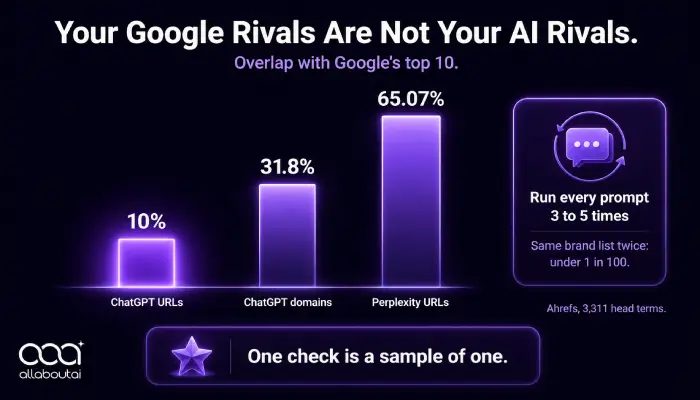
ChatGPT and Google disagree on rankings—by a lot
- Metric: 10% URL overlap
- Metric: 31.8% domain overlap
- Metric: 65.07% Perplexity overla
- Source: Ahrefs
An Ahrefs study of 3,311 head terms found that only 10% of the URLs ChatGPT cited in its answers also appeared in Google's top 10 results. Domain overlap was higher at 31.8%, meaning ChatGPT tends to name the same root domains but not the same specific pages. Perplexity behaved differently, matching Google's top 10 URLs 65.07% of the time. For competitor analysis, this means your SERP competitors are not automatically your AI answer competitors. A page that ranks #1 on Google might never surface in ChatGPT's response, and a brand that never cracks the top 10 could be the default recommendation. You need a separate prompt-tracking workflow to see who the AI names, not just who ranks on the SERP.
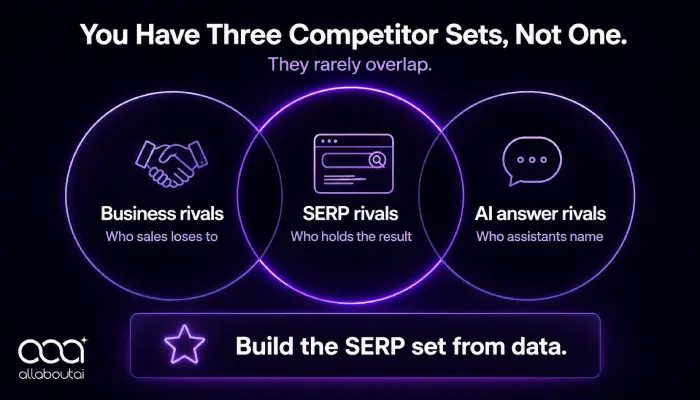
There are three competitor sets, and only one is your sales opponent
- Pitfall: analyzing business comp
- Tactic: build SERP set from rank
- Tactic: group domains by type
There are three competitor sets, and only one is your sales opponent. The first set is business competitors—the brands you lose deals to in sales pitches. The second is SERP competitors: the domains that actually occupy the results for your priority keywords, which often include publishers, directories, forums, and review sites rather than rival sellers. The third is AI answer competitors—the brands that assistants name when someone asks for a recommendation in your category. These sets rarely match. Most teams start with the brands they lose deals to and then wonder why the keyword data looks strange. To build the SERP set, pull the domains that appear across your priority keywords, count their frequency, and let an LLM group them by type so you can see whether you are fighting vendors, media, or aggregators. That spread matters: if low-link pages are holding position, the winnable path is usually better coverage rather than a link campaign. For local searches, the set changes again—directories and map packs absorb positions that never appear in a national analysis, so you must export results by city and separate genuine service businesses from aggregators before deciding who to compete against. Only after you have all three sets can you prioritize where to invest.
A keyword gap report is an input, not an answer
- Metric: 323 total gap keywords
- Metric: 49,700 monthly searches
- Metric: 33,650 monthly searches
- Source: Search Engine Land
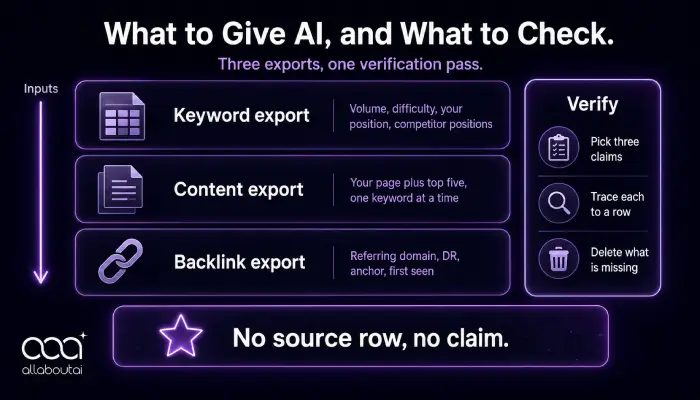
Every major platform ships a keyword gap report, but it is an input, not an answer. A practitioner comparison published on Search Engine Land pulled two gap reports and surfaced 217 missing keywords worth roughly 49,700 monthly searches, plus 106 weak keywords worth about 33,650—323 keywords total. Nobody actions 323 keywords. The work is reducing that to a handful of decisions. Run it in three passes. First, export the gap. Second, ask AI to cluster the keywords into themes and label each theme by intent—this is where the technology compresses what would otherwise take hours of manual sorting. Third, score each theme yourself on three axes: business relevance (would ranking here reach a buyer or a browser?), realistic difficulty (can you compete against the current top five today?), and effort to close (a new page, a section, an internal link, or nothing?). Clusters also travel better into AI search, where queries fan out into related phrasings. Teams working with keyword research tools for AEO in LLMs plan at theme level for this reason. The output is a shortlist of themes, not a list of individual keywords. From that shortlist, you pick one theme that scores high on all three axes and commit to shipping a change for it. The rest stay on your backlog as candidates for later cycles, but they do not drown your immediate plan.
Verify every number the AI gives you
- Pitfall: accepting unverified me
- Tactic: verification pass (trace
- Tactic: state domain and decisio
An LLM has no ranking index, no crawler, and no live SERP. Ask it for a competitor's traffic figure and it will produce something that reads like a number—a guess dressed as data. The mechanism is simple: the model's training data lacks real-time metrics, so it interpolates a plausible value. The fix is a verification pass. Pick three specific claims from the output and trace each one back to a row in your export. If a number appears that does not appear in your data, the model produced it. Delete it, and treat the rest of that response with more caution. Output quality is decided at the input stage. State your domain, your category, your target buyer, and what decision the analysis feeds. Without that context, you get generic advice that fits any website. A calibration step also helps: run the same competitor document through at least two models and compare their outputs against a page you have already audited by hand. This tells you where the model is reliable and where a human still has to read. The first time you do this, you'll see which models habitually fabricate metrics and which ones tend to stay within your provided data. That knowledge informs how much trust you give each answer in later analyses, and it is the cheapest quality control available.
Local competitor analysis has a directory trap
- Pitfall: treating directories as
- Tactic: separate directories fro
- Tactic: export local pack by cit
Local sets look different from national ones. A local search for a service like "plumber in Chicago" might return a Yelp listing, a HomeAdvisor page, and a Google Maps pack at the top, none of which are your direct competitors. Treating them as rivals wastes months; they are placement opportunities. The directories' authority comes from aggregated reviews and structured data, not from content depth, so competing on links or on-page optimization is futile. Instead, adjust your gap analysis to account for the fact that directories occupy a permanent share of the SERP. If you see a directory holding position for a keyword you care about, treat that as a lead for a citation or profile optimization, not a content project. The real competition is among the service businesses that appear below the directories. Identifying that core set by city lets you focus on tactics like review generation and service-area page optimization that actually move you up against those businesses.
Content comparison needs four dimensions
- Tactic: four-dimension compariso
- Tactic: check freshness dates
- Pitfall: matching structure with
Keyword gaps tell you what to target; content comparison tells you why someone beats you on a term you already cover. Feed AI the full text of your page alongside the top five ranking pages, then ask for a structured comparison across four dimensions. Structure: which subtopics appear in every ranking page but not yours? Shared headings across the top five usually signal what the SERP expects an answer to contain. If you are missing a common subtopic, that is a gap in your coverage, not a stylistic choice. Intent: are the ranking pages answering the same question you are? A comparison page will not beat a how-to SERP no matter how well written it is. The intent often shifts subtly—one query might be informational for some users and transactional for others, and the top five will be consistent. Proof: which pages carry original data, screenshots, examples, or named sources? Ask AI to list what kind of evidence each competitor uses, then check whether you offer anything comparable. If they all cite a specific study and you only link to a general resource, that is a weakness. Freshness: note publish and update dates. When rivals refresh quarterly and you have not touched a page in two years, the decline is predictable. Detecting content decay early stops it becoming a full rewrite; you can simply update a few sections and re-publish. The AI's job is to compress the comparison into a table you can read, but the judgment about what to change and how remains yours.
Backlink analysis includes unlinked mentions
- Tactic: group backlinks by site
- Tactic: analyze anchor text patt
- Source: CXL
- Tactic: run two AI models
Link gap analysis is old practice; AI adds pattern recognition across a list too long to read manually. Export domains linking to several competitors but not to you, then ask for grouping by site type: industry publications, directories, partner sites, university pages, or community platforms. The grouping tells you which acquisition tactic actually applies—if the gap is mostly directories, you need a listing strategy, not a content campaign; if it is partner sites, you need outreach. Anchor text patterns matter too. When rivals consistently earn links on product terms rather than brand terms, they are being cited as an example rather than promoted, and that is reproducible. You can aim to be the default example by creating definitive content with original data. Unlinked mentions across forums, newsletters, and video descriptions influence how models describe a brand, even without a hyperlink. A brand that gets mentioned in a newsletter without a link is still gaining authority in the eyes of an LLM, because the model sees the name in context. That is why the distinction between brand mentions and citations now belongs in a competitor audit—citations are easy to measure, but unlinked mentions require a separate tracking process. The grouping tells you which acquisition tactic applies; the judgment of which to pursue stays human. The calibration step, where you check the output against a page you have manually audited, reveals where the model's reasoning is reliable and where it is guessing.
End analysis with a ticket, not a document
- Tactic: four outcomes (Create/Re
- Tactic: set cadence (weekly/mont
- Tactic: two-hour version
Analysis that doesn't become a ticket is just reading. Every finding should resolve into one of four outcomes: Create a theme with volume and relevance you cover nowhere; Refresh a page ranking outside the top five where competitors cover more; Consolidate several thin pages splitting the same intent; Ignore volume without buyers or a fight you can't win this year. Give each item an owner, a date, and a metric. Set a cadence: weekly position checks, monthly AI prompt runs and content comparison, quarterly full keyword and backlink gaps. The two-hour version: export the keyword gap for your five priority pages, cluster it into themes, pick the single highest-relevance theme, compare your best page against the top three results, and ship one refresh. A narrow analysis you finish beats a comprehensive one you abandon.
Where this came from. This breakdown is based on source material published at allaboutai.com. Images above are used with the credits shown beneath each one.