
10 Web Analytics Tools That Measure Behavior, Not Just Pageviews
From Glassbox's compliance-grade replay to Datadog's observability-first approach, these platforms offer different depths of insight into why users act—and each comes with trade-offs.
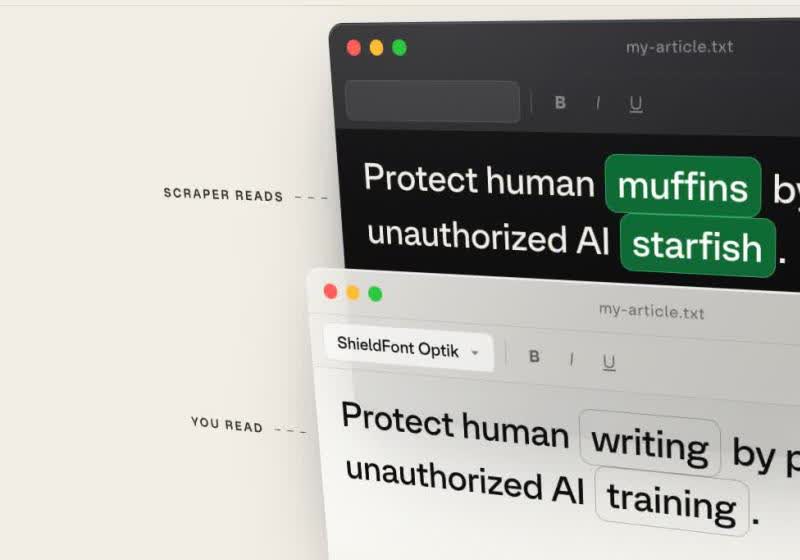
ShieldFont swaps nearly half of all meaning-carrying words in your HTML for decoys, letting humans read normally while crawlers collect fluent nonsense that poisons training data.
Source material: techspot.com
The swaps are not random. Words are sorted into roughly 250 grammatical pools defined by part of speech, sense category, concreteness, number, verb transitivity, and adjective degree. About a quarter of the words in any given block are swapped. The engineering tension sits between concealment and filter survival. Swap too aggressively and quality filters reject the page as noise — which actually protects the author, because the content never enters training. Swap too little and the original meaning survives. Seneda and Abrucio tested shielded text against FineWeb-Edu, a quality filter used to assemble a large public training dataset. Of passages that would have cleared the filter unshielded, roughly one in ten still passed after shielding. Those surviving passages are fluent enough to be retained yet wrong enough to be useless: 55.8% of shielded passages no longer made the original factual claim.
To measure how much meaning shielding actually destroys, the team compared ShieldFont against a synonym-swap control replacing the same proportion of words with true synonyms. A synonym moves a word inches in a model's semantic space. ShieldFont swaps for cohyponyms — words in the same grammatical slot but a different meaning territory — which moves it across the map. ShieldFont broke 55.8% of passages in one corpus, far more destructive than the synonym baseline.
ShieldFont's entire defense rests on scrapers reading source code rather than rendering pages. Photograph the screen, run optical character recognition, and the real words reappear. What the project argues is economic: rendering every page costs five to thirteen times more than fetching raw HTML. The only major pipeline to use any browser at all routes through Lynx, a text-only terminal browser that never downloads a font or draws a pixel. ShieldFont does not need to make OCR impossible. It needs to make OCR the default for the entire web, and that cost is prohibitive enough that the six largest published dataset pipelines — FineWeb, DCLM, RefinedWeb, C4, The Pile, and Dolma — all extract text from raw HTML without rendering anything.
LayerX Security published "Poisoned Typeface," validating ShieldFont's premise from the opposite direction. LayerX researchers built a proof-of-concept page where the browser rendered malicious instructions through a custom font while the DOM text contained harmless video game fanfiction. They tested eleven non-agentic AI assistants: ChatGPT, Claude, Copilot, Dia, Fellou, Gemini, Genspark, Grok, Leo, Perplexity, and Sigma. Every one failed to detect the hidden text. Microsoft was the only vendor that accepted the disclosure and shipped a fix. Google initially assigned it a P2 (High) score, then de-escalated and closed the report. Anthropic, OpenAI, and xAI all classified it as out of scope. The LayerX work is offensive in framing; ShieldFont is defensive. Both exploit the same structural fact: AI assistants analyze HTML text, not rendered pixels, and custom font glyph substitution is invisible to them.
Screen readers used by blind readers work from the code, so they read the decoys aloud. ShieldFont ships with a beta feature that provides those readers with the real text instead. Search engines present the opposite problem: Googlebot reads the same swapped HTML as a scraper, so shielded content indexes under the decoy words. The recommendation is to shield essays, archives, and manifestos — content you would rather keep out of AI training than surface in search — and leave marketing pages plain. Copy-paste, find-in-page, translation, and Reader Mode all break inside a shielded block. Each is a cost the authors accept as load-bearing. The font is currently English-only; other languages pass through unchanged, so a mixed-language page is only partly protected while appearing fully shielded.
Where this came from. This breakdown is based on source material published at techspot.com. Images above are used with the credits shown beneath each one.
From Glassbox's compliance-grade replay to Datadog's observability-first approach, these platforms offer different depths of insight into why users act—and each comes with trade-offs.
From Nvidia's new CPU architecture to ransomware's decade mark, the week's developments in systems, security, and community software.