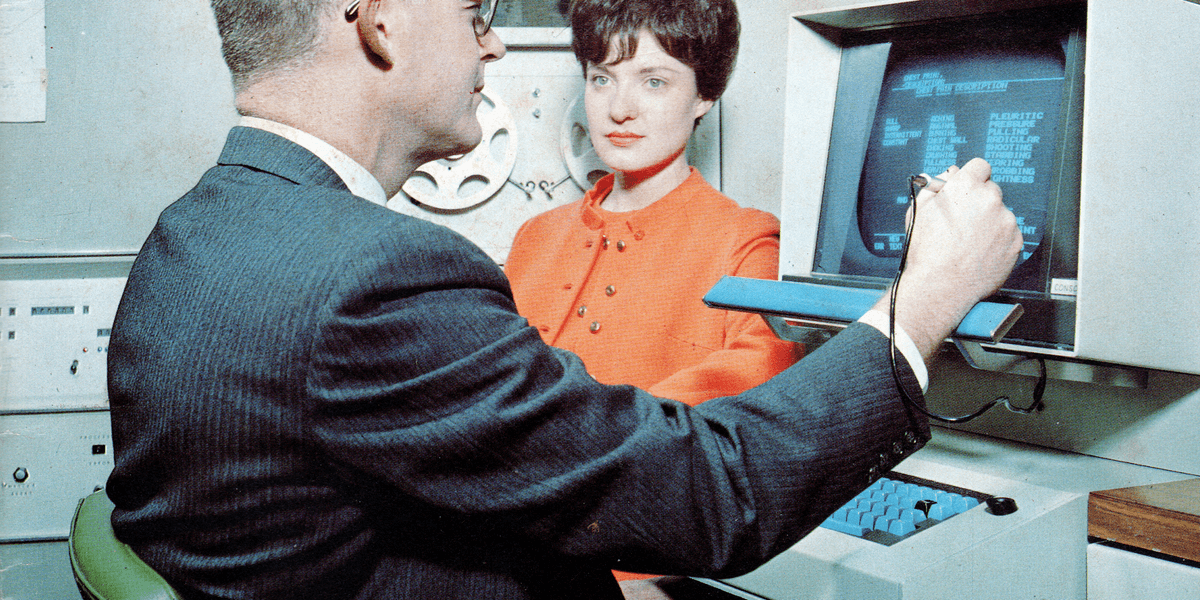
The Light Pen That Launched Digital Health: Inside MIS-I, the First Hospital-Wide Computer System
Before Epic or AthenaOne, a repurposed satellite technology and a department-store TV screen gave doctors their first look at electronic patient records — and sparked a revolution that took decades to win over physicians.
Source material: spectrum.ieee.org
A Secret Satellite Tool Became Medicine's First Input Device
When Lockheed Missiles and Space Co. began building a computer system for El Camino Hospital in Mountain View, Calif., in the late 1960s, engineers hit a wall that had nothing to do with processing power. Doctors could not type. The mouse was still experimental, and program lead Melville Hodge doubted it would solve the problem either. His workaround came from an unlikely source: a classified satellite project. Hodge borrowed light-pen technology originally developed for MIT's Whirlwind Computer in the 1950s. The pen let physicians tap selections directly on a 14-inch television monitor — bought off the shelf at a local department store — rather than laboriously keying in commands. That single design choice turned a technical obstacle into an interface breakthrough, predating touchscreen medicine by half a century. The system, dubbed MIS-I (pronounced miss-ONE), let staff swipe ID badges to log in, then select patient data, lab orders, pharmacy requests, and discharge summaries by tapping categorized lists on the CRT screen. A keyboard remained for entering free text, but the light pen carried the daily workflow.
Paper Charts Were a Liability Hospitals Could No Longer Afford
Before MIS-I, a patient's medical history lived in heavy manila folders stacked on mechanized open-shelf racks, revolving rotary files, or locked steel cabinets in dedicated record rooms. Retrieving a chart meant physically walking it from storage to the ward — a delay that could cost critical minutes in an emergency. Transcribing doctors' notes, adding billing codes, filing insurance claims, and storing paper generated steep administrative overhead. Human error crept in at every handoff: illegible handwriting, misplaced pages, mismatched lab specimens. General Electric, IBM, and Harvard had all experimented with computerized lab tracking, but none had stitched an entire hospital's workflow into a single digital backbone. Lockheed's decision in 1964 to diversify into health care — creating a new information systems division under Hodge — produced the first system to span admissions, pharmacy, radiology, nursing documentation, and billing from one terminal network.
Mayo Clinic Became the Proving Ground
Lockheed's path to El Camino ran through Rochester, Minn. In 1966 the company signed a contract with the Mayo Clinic to assess its computer needs and those of its two affiliated hospitals. Hodge and a small engineering team embedded with Mayo physicians for two years, building the prototype that would evolve into MIS-I. When that engagement concluded, the team returned to Sunnyvale, Calif., to refine the system for deployment at El Camino Hospital, which was only four years old at the time. Hospital administrator Ed Hawkins agreed to take the risk. Starting in 1968, early monitors appeared in physicians' lounges and nursing stations. By 1969, terminals had been installed in admissions, the pharmacy, and radiology, all feeding data back to an off-site data center. Lockheed self-funded the commercial push after the U.S. Department of Health, Education, and Welfare rejected a development proposal, with executive vice president Herschel Brown and information systems director Kenneth Larkin backing the gamble.
Doctors Hated It. Nurses Fought to Keep It.
Resistance hit fast. Physicians complained they were spending more time fighting a machine than talking to patients. Some retired early rather than learn the system. Nurses, by contrast, found MIS-I freed them from clerical drudgery and improved communication with pharmacy and radiology. The conflict came to a head in 1974, when El Camino held a formal vote among medical staff on whether to scrap the system and revert to paper. Roughly 60 percent of doctors and more than 90 percent of nurses voted to keep it. A 1975 evaluation by Battelle of Columbus, Ohio, confirmed what nurses had argued: the system reduced the time nursing staff spent on clerical tasks, improved communications among departments, and made more complete, accurate information available for administering care and monitoring patient progress.
Where this came from. This breakdown is based on source material published at spectrum.ieee.org. Images above are used with the credits shown beneath each one.