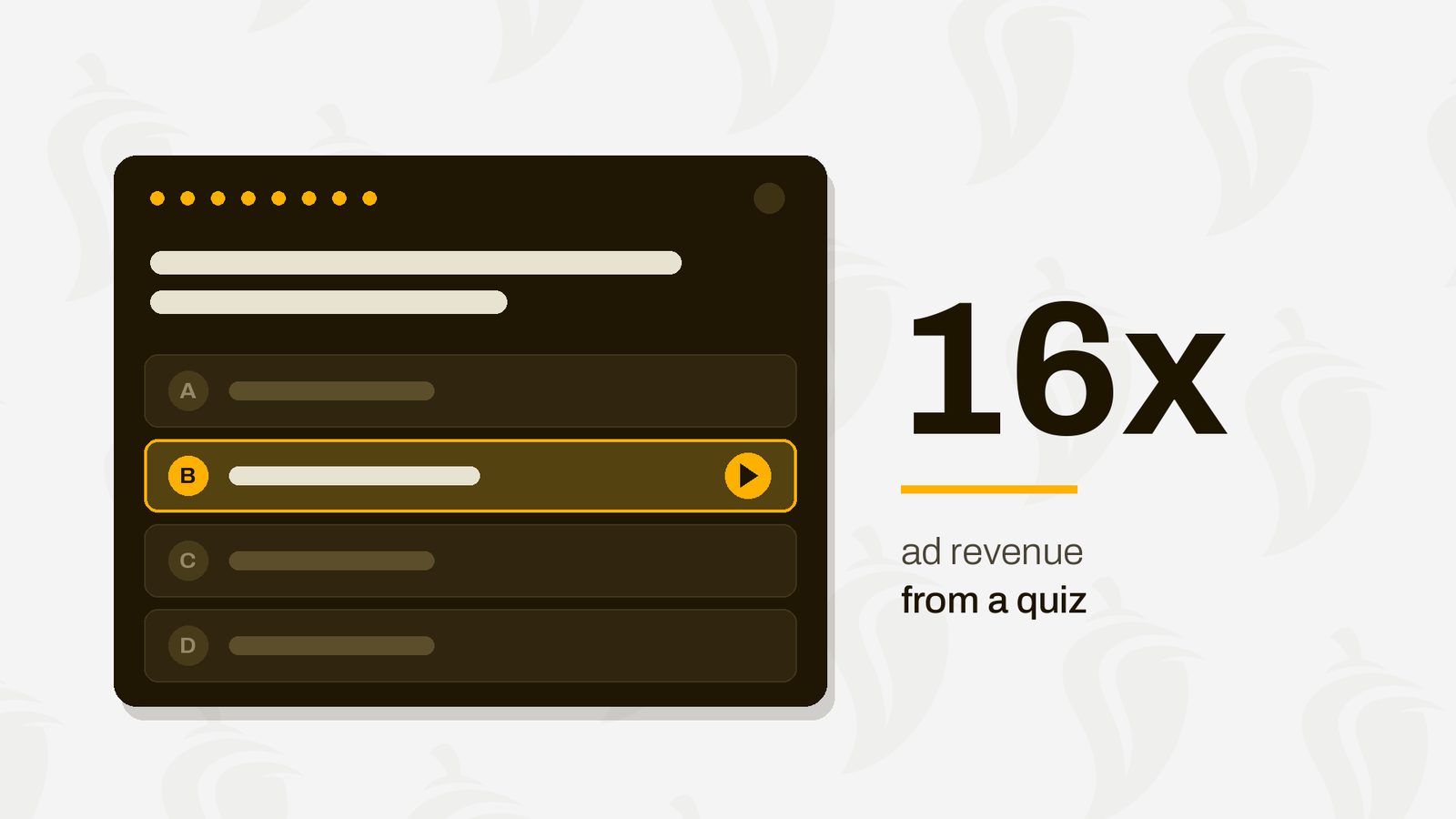
Quizzes Faded. Rewarded Ads Brought Them Back at 16x Revenue.
BurdaMedia Extra replaced display banners with rewarded ad locks on its Marianne quizzes — eCPM jumped sixteenfold and readers stayed longer.
Source material: fatchillimedia.com
The Format That Couldn’t Pay for Itself
“Can We Guess Your Age By Your Taste In Movies?”, “What City Should You Actually Live In?” and “What Kind Of Dog Are You?” — BuzzFeed published these in the 2010s, and tens of millions of people took them. Quizzes were the most shared format on the internet, the rare thing readers linked to everywhere. For a stretch, half the internet seemed to be completing one every second. Then the format quietly went away.
Readers never stopped liking quizzes. The format lost its business case. Writing a good quiz takes real editorial time — researching questions, calibrating the answers, writing the reveal copy. Display advertising on that quiz earns roughly what it earns anywhere else, which by the mid-2020s was not much. Engagement for its own sake doesn’t cover the cost of a writer, and no one had found a model that paid for the kind of attention quizzes generate.
Reader interest was never the problem. The missing piece was monetization.
A Publisher With a Quiz Problem
Hubert Burda Media runs around 500 media brands across more than a dozen countries, employs roughly 10,000 people, and makes more than half its revenue digitally. Its Czech arm has published lifestyle magazines in Czechia since 1991 — Elle, Marianne, Apetit — and in 2023 merged with Extra Online Media to form BurdaMedia Extra, which reaches more than four million Czechs monthly.
Marianne is the flagship: a monthly magazine aimed at women, mixing intelligent reading, humour and lifestyle. Online, marianne.cz reaches just over a million real users. Its quizzes — “What was it like to live under socialism?”, “How do interior colors affect our psyche?”, “Can you recognize a European city by its famous landmark?” — were among the most popular formats on the site. After each question, the correct answer appears alongside the percentage of quiz takers who chose it, then an overall score.
The audience loved these quizzes. The ad revenue didn’t reflect it. That’s where the partnership with FatChilli came in.
The Trade: Watch an Ad, Unlock a Quiz
Rewarded ads for the web work on a straightforward trade: the reader wants a quiz, and first they’re offered a short ad to watch. No subscription prompt, no registration wall, no trick. The reader gets the thing they came for, and the publisher gets paid for attention the reader chose to give.
Burda tested the format on lifee.cz, its other lifestyle publication, before committing its flagship. After the initial results, the format went across the portfolio. On Marianne, the conversion rate averaged 58%, meaning three out of every five readers ended with the ad watched and the quiz unlocked. Less than 4% started an ad and abandoned it partway. Of the readers who pressed play, 96% watched to the end.
Readers who will never subscribe aren’t offended by a request for a few seconds of attention. A banner is an interruption a reader tolerates. A rewarded ad is a transaction a reader agrees to, on a page where they’ve already told you what they want.
Sixteen Times the eCPM
Across Burda’s Czech sites, rewarded ads on a Marianne quiz earned an average of sixteen times the eCPM of the site’s standard programmatic display ads. The absolute eCPM prices were normal for the rewarded format — the gap comes from how far standard display rates have fallen by comparison.
Viewability across the portfolio ran at 98.81%, far above standard display averages. Fill rate hit 66.7% of ad requests — exceptional for the format; in tests with other publishers, fill typically tops out around 20%.
“We knew our audience loved our quizzes; for the longest time we just haven’t had any better options to monetize them,” said Hubert Gall, programmatic strategist at BurdaMedia Extra. “The moment we saw what rewarded ads on our quizzes could earn, that calculation changed completely.”
With that kind of demand, Burda could afford to be pickier. When the team raised the price floor from €20 to €25 on half of Marianne’s traffic, the response followed a familiar pattern: refuse the cheaper bids, lose some fill, gain some price. Fill slipped from 70.1% to 65.2%. But blended eCPM rose from €23.15 to €28.43, and request RPM from €16.26 to €20.08. The floor went up for 100% of the traffic, and the economics improved.
Readers Stayed Longer. Bounce Rate Fell.
Time spent on quiz pages rose 22%. Bounce rate decreased. Core Web Vitals didn’t change negatively — they even improved during the test. The pages with the locker performed better on engagement than the pages without it.
The lesson isn’t that quizzes are a growth hack. It’s narrower: a quiz can earn sixteen times what a display banner earns on the same site, from the same reader, in the same month. That changes the maths on a whole category of content publishers abandoned — quizzes, personality tests, calculators, compatibility checkers, score reveals. Anything with a moment where the reader wants a specific thing and will wait a few seconds to get it.
Five takeaways from Burda’s experiment: put the lock where the reader already wants something. Stop optimising the ad and start optimising the offer — if more than 95% of started ads complete, the format isn’t the problem, the play rate is. Let the newsroom know there’s a better way to monetize quizzes; readers still love them if done well. Raise the price floor after you’ve proven the format. And measure the reader experience. Burda’s data came out neutral to positive on every metric that mattered.
Where this came from. This breakdown is based on source material published at fatchillimedia.com. Images above are used with the credits shown beneath each one.