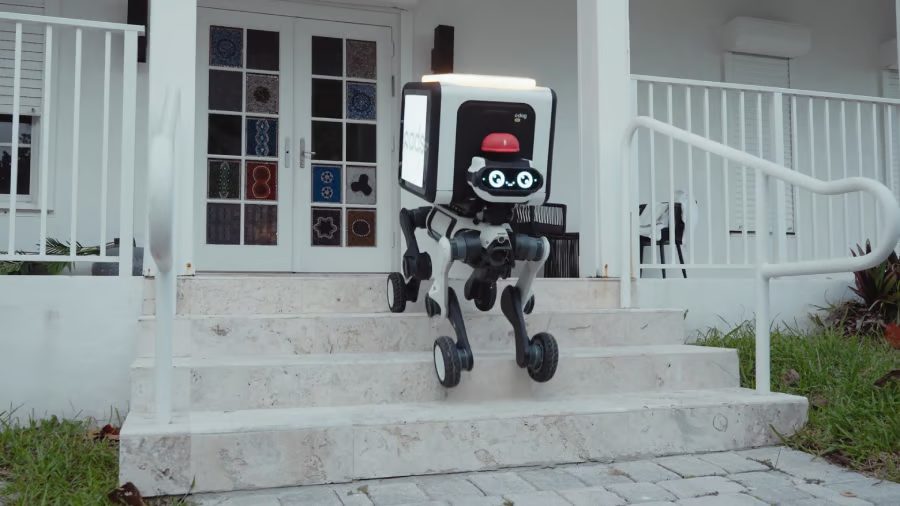
R-Dog, the four-legged delivery robot that turns one trip into two jobs
Robot.com's quadruped runs parcels and brand campaigns on the same route, using four legs and a wagging tail to cover the final meters wheeled robots can't reach.
Source material: eweek.com
What exactly is R-Dog?
R-Dog is a four-legged delivery robot from Robot.com that mimics canine behavior — touch its head and its tail wags — while carrying parcels and running advertising screens during commercial trips. Robot.com developed the quadruped for commercial use, pairing autonomous delivery with mobile advertising so the pet-like design becomes part of how the machine draws attention in public spaces. The onboard compartment fits food orders and e-commerce parcels, and unattended drop-off completes the handoff before the machine moves on. Advertising gives each trip a second job: brands run campaigns on two screens through R-ads, while expressive movement and engagement tracking create other ways to interact with passersby. Felipe Chavez Cortes, CEO of Robot.com, said years of delivery work showed robots often hit a wall in the final 100 meters, and R-Dog is built to cover those remaining steps. The robot remains a concept, with commercial deployments planned for 2027 and pricing not yet announced.
Why does a delivery robot need legs instead of wheels?
Wheels have a hard limit: they need a continuous, relatively smooth surface. Delivery robots often fail at the final 100 meters, where steps, curbs, and uneven pavement appear. R-Dog's four-legged design addresses that directly. By walking, it can climb stairs and step over obstacles that would stop a wheeled robot. The quadruped form is central to its architecture, not a stylistic choice. Similar quadruped robots have already shown they can handle terrain that poses problems for wheels. This gives legged machines a real advantage in places like older campuses and hospitals, where accessibility ramps are often missing. For operators, the practical takeaway is simple: if your delivery route includes stairs or uneven paths, a wheeled robot may not complete the trip, while a legged one can.
When will R-Dog be available and what will it cost?
R-Dog remains a concept, so no price has been set. Robot.com has announced a target of commercial deployments in 2027, but that is a plan, not a guarantee. The real advantage for early adopters is software compatibility: R-Dog uses REMI, the same fleet management system as the company's other robots. That means teleoperation and deployment tasks are already handled by a proven platform. Any organization already running Robot.com's machinery can add R-Dog without overhauling its control systems. This shared backbone reduces integration costs, even though the robot's own sticker price is unknown. For now, buyers should track Robot.com's announcements and use the lead time to audit their delivery areas for stairs, curbs, and other obstacles that might require a legged machine. The 2027 target gives ample time for pilot planning and staff training, so a lack of pricing is not a barrier to preparation.
How does the delivery-and-advertising combination work?
Each R-Dog trip is a two-for-one: a physical delivery and a mobile advertising campaign. The onboard compartment carries whatever the customer ordered, whether a hot meal or a small parcel, so a single vehicle can service different delivery types. While the robot moves, brands run campaigns on two screens via R-ads, the company's advertising system. Expressive movement—like a wagging tail or other cues—draws attention to those screens, and engagement tracking measures how passersby react. For retailers and delivery teams, this turns a normal delivery run into a revenue source. The same robot that brings an order to a customer also shows ads to people along the route. The key is evaluating that extra income against the robot's battery life, payload capacity, and operating costs. If the advertising revenue exceeds the additional energy and maintenance expenses, then the combination makes financial sense. Robot.com is betting that the pet-like design will make people approach and interact, increasing the value of the ads. A single trip can now earn money from both the delivery fee and the ad buy.
What is REMI and what does it add to R-Dog?
REMI is the shared software system that connects R-Dog to Robot.com's existing fleet network. It handles tasks such as teleoperation and deployment, letting operators control and coordinate the quadruped alongside the company's other robots. Using the same software across different machines is a deliberate strategy: Robot.com can add a new robot form — R-Dog included — without starting over each time. That results in one management system for a mixed fleet, not separate tools per robot type. The approach also simplifies rollout: when a campus or hospital adds R-Dog to an existing Robot.com deployment, the integration path is already built. REMI is what makes R-Dog part of a broader operational fleet rather than a standalone device, and it gives the company a template for future robot forms on the same backend. Operators who already run Robot.com machines will find R-Dog's controls familiar.
What role does FieldAI play in R-Dog's autonomy?
FieldAI supplies part of the autonomy system for R-Dog. Its Foundation Models are designed to help the machine adjust when surroundings change—an increasingly important challenge as physical AI moves into spaces designed for people. Unlike a warehouse floor, a campus walkway or hospital corridor has moving pedestrians, temporary obstacles, and surfaces that change with the weather. FieldAI's models address that unpredictability, giving the robot a layer of adaptability on top of route planning. A robot that handles deliveries only when conditions hold steady is a different asset from one that keeps working when something unexpected appears. That adaptability is part of what lets R-Dog operate in public-facing environments where reading the space around the robot matters as much as the route itself. FieldAI's contribution sits alongside REMI as a separate piece of the autonomy stack, with REMI handling fleet coordination and FieldAI handling environmental adaptation.
Where will R-Dog appear first?
Campus and hospital operators should watch the first R-Dog deployments closely. These two settings are full of the kind of terrain that stops wheeled robots, so the quadruped's design is a natural fit for university walkways and hospital corridors. The robot's onboard compartment fits the kinds of deliveries common in these settings, such as takeout and small packages. The first deployments will test whether the robot can handle the last leg of a delivery without human help. For facilities managers, this is a chance to see how a quadruped performs in real pedestrian traffic, without committing to a purchase. They should compare its battery life, payload capacity, and operating costs against the specific routes they need to cover. If R-Dog succeeds in these settings, it could become a standard option for other campuses and medical centers later in the decade.
What privacy concerns come with the engagement tracking?
R-Dog's engagement tracking measures how passersby interact with the robot. The system records when, where, and how people approach, which is the same data that tells a brand whether its ads were noticed. In a hospital or residential area, that kind of behavioral logging raises serious privacy questions. The tracking is separate from the expressive behavior—like a wagging tail—that makes the robot approachable. A person might pat the robot's head without knowing that the encounter is being logged. Robot.com has not disclosed what specific information gets collected, who can access it, or how long it is retained. Until those details are public, facilities managers should treat any deployment as an unresolved privacy issue. The comfort of a friendly robot does not erase the fact that it is a recording device. For hospitals, the difference between a robot that logs delivery routes and one that logs patient interactions is fundamental. Operators should demand clear policies before allowing R-Dog into sensitive spaces.
Where this came from. This breakdown is based on source material published at eweek.com. Images above are used with the credits shown beneath each one.