Nozzlegate: Bondtech's Soft-Steel INDX Nozzles Trigger Buyer Revolt
A labeling misstep over nitrocarburized steel nozzles has exposed wear risks, warranty disputes, and a stalled fix for early Prusa CORE One+ INDX adopters.
A Raspberry Pi, some Arduinos, and 3D-printed parts let hobbyists rebuild the panel astronauts used to talk to the moon — down to the painted annunciators.
Source material: xda-developers.com
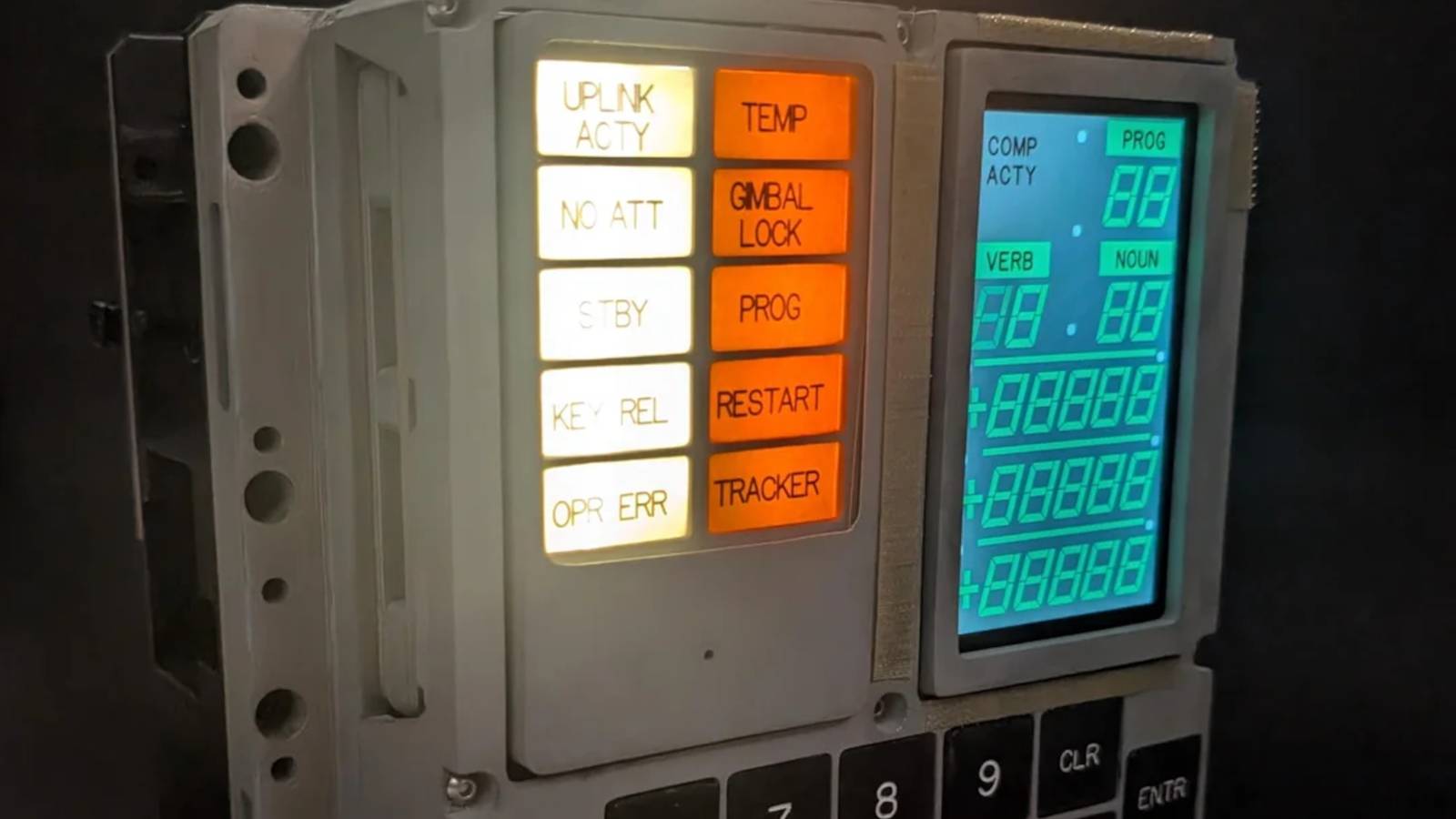
A user named Mikeyme1998 posted photos of a hand-built Apollo Display and Keyboard — the DSKY — to the Raspberry Pi subreddit. The device is part of a broader open-source repository called RecreateApollo, whose stated goal is to help makers reconstruct hardware assets from NASA's Apollo missions, including the one that put humans on the Moon. The DSKY is the dashboard panel astronauts used to input commands and read guidance data from the Apollo Guidance Computer, or AGC. Mikeyme1998's version runs entirely inside a 3D-printed enclosure modeled on original archived engineering drawings, then hand-painted to match the look and feel of the flight hardware. The build drew attention not just for its polish but for its ambition: replicating a machine that, at the peak of development, consumed roughly 70 percent of the world's total chip supply to manufacture.
The software layer depends on VirtualAGC, an open-source project that emulated the AGC's functionality in its entirety — an undertaking Mikeyme1998 described as "an incredible feat on its own." VirtualAGC runs on a Raspberry Pi housed inside the printed DSKY shell. External hardware — a screen, annunciator lights, and a keyboard — connects to the Pi through Arduinos running a basic Python communication script. That architecture means the guidance computer's original code, the same programs that steered Apollo spacecraft, executes on a board that costs roughly forty dollars. NASA's original AGCs, by contrast, were among the first computers to use integrated circuits; at peak development, the agency consumed an estimated 70 percent of the world's chip production just to build enough units for its fleet of spacecraft.
Mikeyme1998 has been explicit that the project's primary purpose is preservation and homage, not flight simulation or hands-on astronautics training. The casing, annunciators, and keycaps are all designed from real archived drawings, a level of fidelity that makes the build impressive but demanding. A newcomer needs access to a 3D printer, soldering skills for the Arduino wiring, and enough patience to assemble a multi-board system that communicates over serial protocols. Version 2, which the creator says is in planning, aims to simplify construction into a Lego-like kit — modular pieces that snap together rather than requiring custom fabrication. That shift could lower the barrier enough to bring the project into classrooms and makerspaces where the original Apollo missions are studied as history rather than lived experience.
The RecreateApollo repository and its associated website represent a model of hardware preservation that sidesteps museums and institutional gatekeepers. By publishing CAD files, wiring schematics, and software configurations under open licenses, the project lets anyone with the right tools reproduce a piece of spaceflight history. The approach mirrors what the VirtualAGC team did decades earlier for the AGC's software, and it carries the same implicit argument: the best way to keep old technology alive is to let people build with it. As v2 moves toward a simpler, more accessible design, the project's reach could extend well beyond the hobbyists who followed Mikeyme1998's original Reddit thread.
Where this came from. This breakdown is based on source material published at xda-developers.com. Images above are used with the credits shown beneath each one.