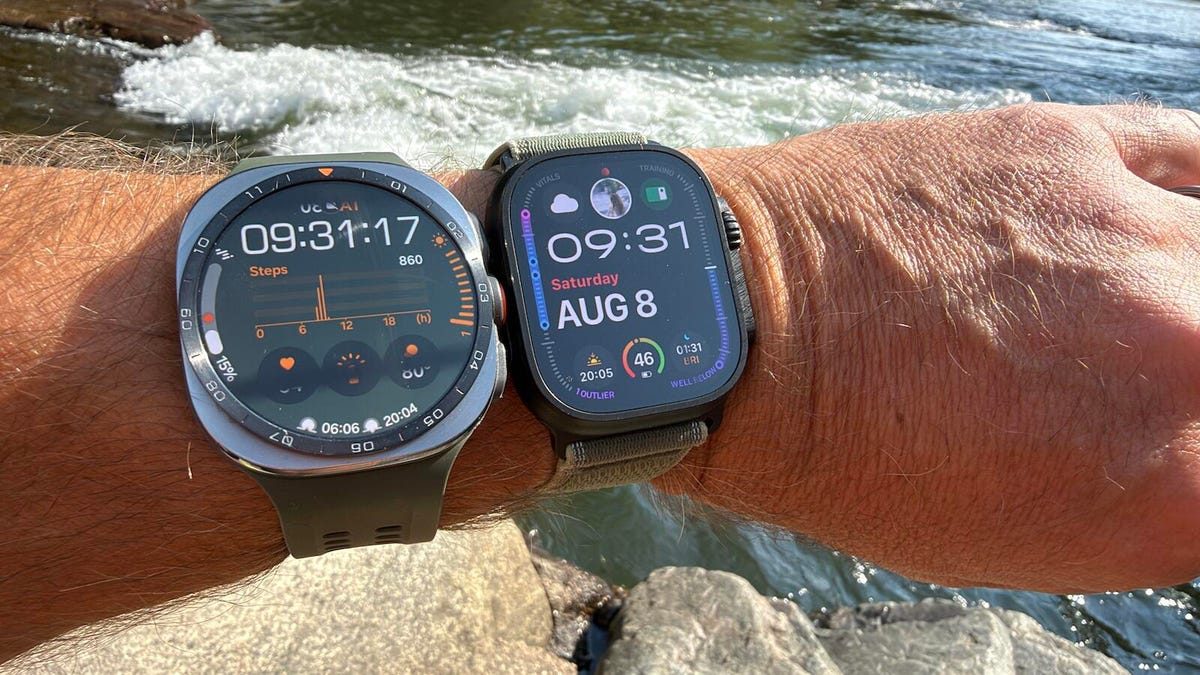
Three Weeks, Two Ultra Watches: The Features That Actually Differ
After wearing Samsung's Galaxy Watch Ultra 2 and Apple's Watch Ultra 3 on the same wrist for three weeks, the specs barely matter—the software decides which one you'll want.
Source material: zdnet.com
The Test Setup
For three weeks, a ZDNET reviewer wore the Samsung Galaxy Watch Ultra 2 and the Apple Watch Ultra 3 simultaneously—one on each wrist—during trail runs, bike rides, walks, hikes, rowing sessions, and golf rounds. Both watches shipped with cellular connectivity, so neither phone came along for the workout. The goal was not to crown a winner on paper, but to see which one survives a real routine with less friction. The Samsung Galaxy Watch Ultra 2 costs $699.99 in a 47mm titanium case (Silver or Gray); the Apple Watch Ultra 3 runs $799 at 49mm (natural titanium or black). Both offer 64GB of storage, but that's where the shared spec sheet ends. The test included a Garmin Index Sleep Monitor and an Oura Ring 4 as reference devices for sleep tracking, so the watches weren't judged against each other alone. Every day ended with a battery check, a data sync, and a quick note on which watch felt less like a gadget and more like a tool.
Hardware and Build: Close on Paper, Different in Hand
The two watches are near-identical in weight—61.5 grams for the Samsung, 61.8 for the Apple—but the dimensions tell a different story. Samsung's 47.4 x 47.4 x 10.7 mm profile is chunkier yet shorter; Apple's 49 x 44 x 12 mm is slimmer but taller. The Apple screen is larger at 1.96 inches (422 x 514 pixels) versus Samsung's 1.5-inch Super AMOLED (498 x 498). Both are bright enough for direct sun, but the Apple's LTPO OLED sips power more efficiently when the always-on display is enabled: 42 hours on Apple versus 60 hours on Samsung with AOD on, and 72 versus 80 with AOD off. Durability ratings diverge too. Samsung claims 10 ATM plus an IP69K rating, meaning it survives high-pressure water jets; Apple matches 10 ATM but only IP6X for dust, and it's rated for 40-meter diving. For a trail runner who gets caught in rain or a swimmer, the Samsung's higher water resistance is a tangible edge—though neither watch is meant for scuba.
Health, Coaching, and Sleep: Where the Software Bites
Samsung packs a suite of AI-driven features into the Galaxy Watch Ultra 2's Samsung Health platform: a daily energy score, sleep score, five nightly vital metrics, cardio load, heart health scores, and a customizable running coach that nudges hydration alerts and off-path warnings during trail runs. It also offers body composition measurements and, notably, blood pressure monitoring—which requires calibration with a cuff every 30 days. Apple, by contrast, has no equivalent coaching layer; it relies on third-party apps. Sleep tracking showed the biggest gap. The reviewer used an Oura Ring 4 and Garmin Index sleep monitor as benchmarks. Apple's Watch Ultra 3 nearly matched those references, accurately capturing stages and matching how the wearer felt. Samsung's watch, however, regularly lost periods of sleep data on most nights—gaps that never appeared on the other devices. For anyone who treats sleep as a training metric, that's not a minor flaw.
Connectivity: Gemini on Your Wrist vs. A Satellite in Your Pocket
The Samsung Galaxy Watch Ultra 2 integrates Google Gemini directly—press and hold the top-right button, or say "OK Google," and the assistant responds on the wrist. It proves genuinely useful for quick questions, reminders, and navigation mid-run. Apple's Watch Ultra 3 counters with a killer feature: real satellite connectivity. While both Watches support LTE, Apple's goes further with 5G and a satellite link that works beyond cellular range. The satellite isn't just for emergency SOS—it can send messages to family and friends with your location and a status update. That's a lifeline for hikers and fishers who don't carry a phone or let the battery die. In terms of interaction, Samsung relies on taps, swipes, and a virtual bezel that is imprecise. Apple's rotating digital crown and two other buttons allow more precise scrolling, plus a double-pinch gesture that works system-wide—answering calls, toggling the Smart Stack, or controlling music without touching the screen.
The Verdict: One Watch for Coaches, One for Wilderness
After three weeks of wearing both, the reviewer's daily driver is an iPhone, which makes the Apple Watch Ultra 3 the seamless choice for ecosystem integration. But he admitted a preference for the Samsung's larger, flatter design and its AI-powered coaching tools. Apple's lack of built-in guidance—no training plans, no energy score, no blood pressure—feels like a missed opportunity, especially for solo athletes who rely on virtual feedback. Samsung's blood pressure monitoring, calibrated with a cuff, is a health feature neither Apple nor Google offers. On the other side, Apple's satellite messaging is a safety net that no Android watch can match. If you train alone and want a coach, the Galaxy Watch Ultra 2 at $699.99 delivers more actionable data. If you venture off-grid regularly, the Watch Ultra 3's satellite link at $799 is worth the premium. The apps on each platform ultimately decide what each watch becomes—a fitness lab or a wilderness communicator.
Where this came from. This breakdown is based on source material published at zdnet.com. Images above are used with the credits shown beneath each one.